Pre-Engineered vs. Custom Robotic Welding Cells: Which Do You Need?
Most manufacturers know they need robotic welding — the real question is what type of system they need. Should you choose a pre‑engineered welding cell or invest in a custom engineered solution?
The answer depends on your parts, weld access, throughput requirements, and long‑term production goals. This guide breaks down the differences so you can make the right decision the first time.
You’ll learn:
• What pre‑engineered welding cells include • When custom systems are required • Cost differences between the two • How part geometry affects system choice • Deployment timelines • ROI considerations • How KC Robotics helps you choose the right path
This is the 2026 guide for manufacturers evaluating robotic welding — clear, direct, and built for real decision‑makers.
What Is a Pre‑Engineered Robotic Welding Cell?
A pre‑engineered welding cell is a standardized, pre‑validated robotic welding system with fixed dimensions, safety architecture, and mechanical design. These systems are built to handle a wide range of common welding applications with predictable performance.

A typical pre‑engineered cell includes:
- FANUC robot (standard reach and payload)
- Welding power source (Miller, Fronius, ESAB or Lincoln)
- Fixed or dual‑station tables
- Standard guarding and safety interlocks
- Pre‑designed cable routing and torch management
- Basic fixturing options
- Fast deployment and predictable cost
Pre‑engineered cells are ideal when your parts fit within standard reach, weight, and weld access requirements.
What Is a Custom Robotic Welding System?
A custom robotic welding system is engineered specifically for your parts, welds, and production requirements. These systems are built when standard cells cannot provide the required access, throughput, or flexibility.

Custom system typically include:
- Multi-axis positioners (single-axis, dual-axis, H-frame, skyhook, ferris wheel)
- Large-format robots or extended-reach models
- Coordinated motion between robot and positioner
- Complex or multi‑SKU fixturing
- Servo‑Robot seam tracking or adaptive welding
- Integrated part presentation or automated loading
- Custom guarding and safety layouts
Custom systems are the right choice when your parts demand engineered motion, advanced weld access, or high throughput.
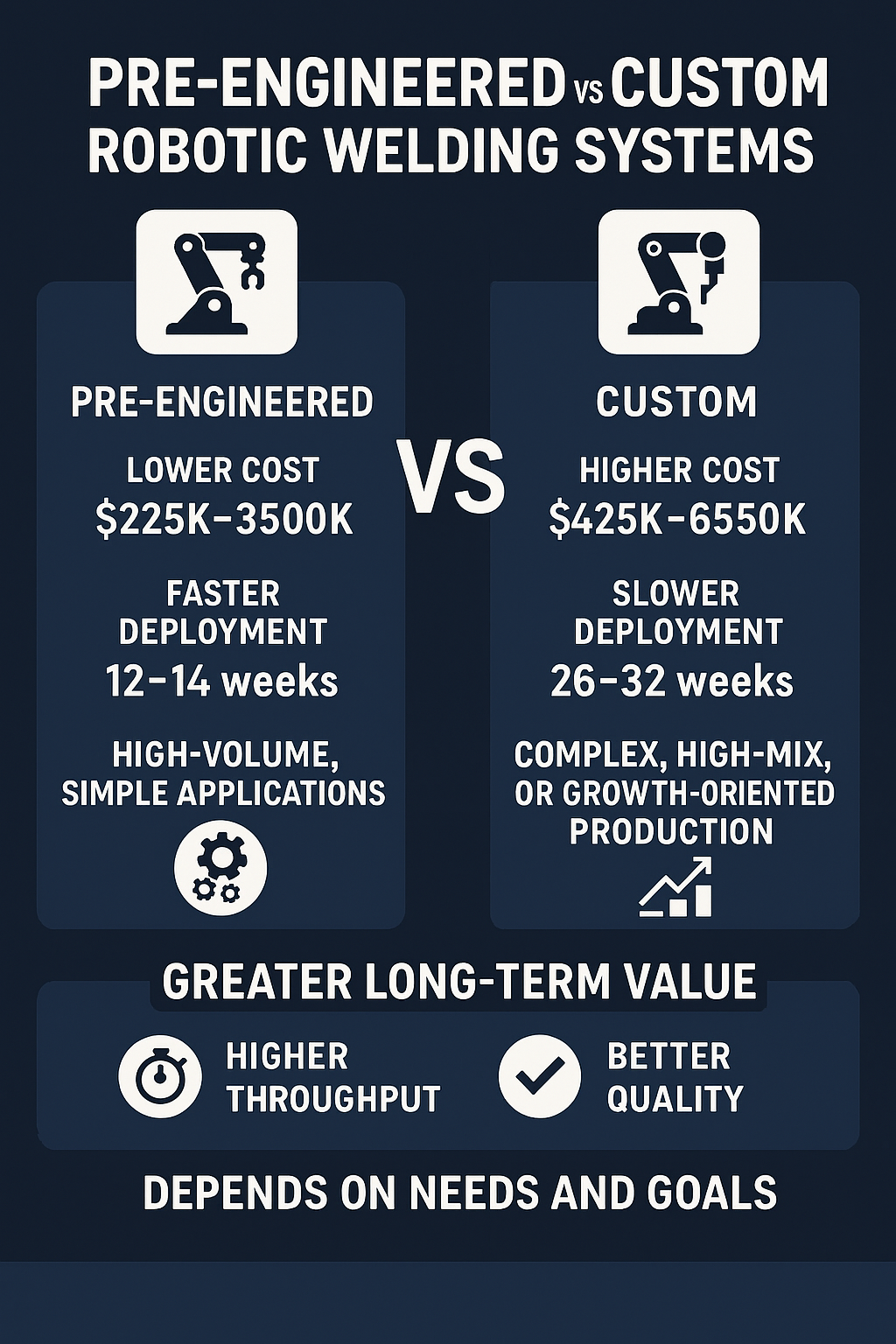
Cost Comparison: Pre‑Engineered vs Custom Welding Cells
Pre‑engineered welding cells $85,000 – $180,000
Custom engineered welding systems $200,000 – $350,000+
Why the difference?
Pre‑engineered cells cost less because:
- Mechanical design is already validated
- Safety architecture is standardized
- Integration time is reduced
- Fixturing is simpler
- Deployment is faster
Custom systems cost more because:
- They require engineering hours
- Positioners add mechanical and control complexity
- Fixturing is more advanced
- Programming time increases
- Layout and safety design are unique
If your parts fit a standard cell, you save money. If they don’t, a custom system is the only path to reliable weld quality.
How Part Geometry Determines the Right System
Your parts are the deciding factor.
Pre‑engineered cells work best when:
- Parts are small to medium size
- Weld access is straightforward
- Parts can be fixtured simply
- Welds are reachable without rotation
- Production volume is moderate
Custom systems are required when:
- Parts are large, heavy, or awkward
- Welds require rotation for torch angle
- Access requires coordinated motion
- Multiple SKUs must run in one system
- You need high throughput or multi‑robot setups
If the robot can’t reach every weld with proper torch angle, you need a custom system — no exceptions.
Deployment Timeline: Pre‑Engineered vs Custom
Pre‑engineered welding cells 8–14 weeks
Custom engineered welding systems 16–32+ weeks
Why the difference?
Pre‑engineered cells are fast because:
- Mechanical design is complete
- Safety is pre‑validated
- Integration is repeatable
- Programming is straightforward
Custom systems take longer because:
- Positioners require engineering
- Fixturing is more complex
- Weld access studies take time
- Programming is more extensive
- On‑site commissioning is longer
If speed matters, pre‑engineered wins. If performance matters, custom wins.
ROI Considerations
Both system types deliver strong ROI, typically 12–24 months, but the drivers differ.
Pre‑engineered ROI is driven by:
- Lower upfront cost
- Faster deployment
- Immediate labor reallocation
- Consistent weld quality
Custom system ROI is driven by:
- Higher throughput
- Reduced scrap on complex parts
- Multi‑SKU flexibility
- Long‑term production stability
The right system is the one that aligns with your production goals — not the cheapest or the most complex.
When KC Robotics Recommends Pre‑Engineered Cells
We recommend pre‑engineered welding cells when:
- Your parts fit standard reach and payload
- Weld access is simple
- You need fast deployment
- You want predictable cost
- You’re automating welding for the first time
KC Robotics is the exclusive United States distributor/integrator for Motofil robotic welding cells, which offer proven designs for fast deployment and predictable performance.
When KC Robotics Recommends Custom Systems
We recommend custom engineered systems when:
- Your parts require rotation or coordinated motion
- Weld access is complex
- You need multi‑axis positioners
- You run multiple SKUs
- You need high throughput
- You require advanced sensing (Servo‑Robot, through‑arc, laser tracking)
Custom systems are built around your parts — not around limitations.
Why Choose KC Robotics for Welding Integration?
KC Robotics designs both pre‑engineered and custom robotic welding systems using FANUC robots, advanced welding power sources, engineered fixturing, and application‑specific programming.
We specialize in:
- Application engineering
- Weld process development
- Fixturing design • Positioner integration
- Simulation and reach studies
- Multi‑SKU programming
- Lifecycle support
Whether you need a fast‑deploying standard cell or a fully engineered custom solution, KC Robotics builds systems around your parts, your welds, and your production goals.
Learn more about the KC Robotics integration team: https://www.kcrobotics.com/about-us/
Ready to Evaluate Your Parts?
If you’re evaluating pre‑engineered vs custom robotic welding systems, contact KC Robotics to review your parts, goals, and timeline: https://www.kcrobotics.com/contact-us/
FAQ
A: A pre‑engineered cell is a standardized, pre‑validated welding system with fixed dimensions and safety architecture. A custom system is engineered specifically for your parts, weld access, and production requirements.
A: Most pre‑engineered welding cells cost $85,000 to $180,000, depending on robot size, power source, and fixturing.
A: Choose a pre‑engineered cell when your parts fit standard reach and payload, weld access is simple, and you want fast deployment at a predictable cost.
A: You need a custom system when parts require rotation, coordinated motion, complex fixturing, multi‑SKU flexibility, or advanced sensing such as Servo‑Robot seam tracking.
A: Pre‑engineered cells deploy in 8–14 weeks. Custom systems deploy in 16–32+ weeks, depending on engineering and fixturing requirements.
A: Custom systems don’t inherently produce better welds — they simply provide the access and motion required to achieve proper torch angle and travel speed on complex parts.
A: Yes. Both pre‑engineered and custom systems can run multiple SKUs with the right fixturing and programming strategy.
A: You need a positioner when weld access requires rotation or when maintaining proper torch angle is impossible with a fixed table.
A: Both deliver strong ROI (typically 12–24 months). Pre‑engineered ROI is driven by lower cost and fast deployment. Custom ROI is driven by throughput, flexibility, and reduced scrap on complex parts.