TOP 5 Robotic Automation Solutions for Metal Fabricators
Metal fabricators across North America are facing unprecedented pressure—labor shortages, demand for tighter tolerances, rising costs, and the push toward Industry 4.0. As fabrication shops search for ways to improve throughput, consistency, and profitability, robotic automation has become the fastest‑growing and highest‑ROI investment category.
From welding and cutting to finishing and material handling, automation is transforming metal fabricators shop floors into a safer, smarter, and more productive environments.
This guide breaks down the Top 5 robotic automation solutions metal fabricators are adopting today, based on industry research and technology trends.
1. Robotic Welding Systems (Arc, Spot, Laser)

Robotic welding remains the most impactful automation category for fabricators because it directly replaces one of the most labor‑intensive and skill‑dependent processes. Automation brings significant gains in consistency, speed, and cost control.
Industry reports show that robotic welding robots and cobots deliver superior repeatability and reduced error rates, supporting sectors such as aerospace, automotive, and industrial equipment manufacturing.
Leading suppliers, including FANUC, offer advanced arc welding robots equipped with ArcTool software and integrated sensors that maximize weld quality while enabling automated seam tracking and adaptive welding.
Why It Matters:
- Addresses severe skilled welder shortages
- Reduces rework and scrap
- Supports 24/7 production
- Delivers the highest ROI for many welding shops
2. CNC Automation & Robotic Machine Tending

CNC machining remains foundational to metal fabrication, and its evolution is being driven by robotic automation. Machine tools now include automation interfaces, reducing the cost and complexity of adding a robot or cobot to tend the machines.
Robotic machine tending automates the loading, unloading, and part‑handling tasks that often bottleneck machining workflows. Automatic part transfer allows machines to run continuously with minimal downtime, improving both throughput and consistency. Many integrators, including KC Robotics, offer turnkey tending systems for lathes, mills, and press brakes.
Why It Matters:
- Eliminates idle machine time
- Reduces reliance on difficult‑to‑hire CNC operators
- Ensures consistent part presentation
- Scales high‑mix or high‑volume production
3. Smart Cutting & Bending Systems
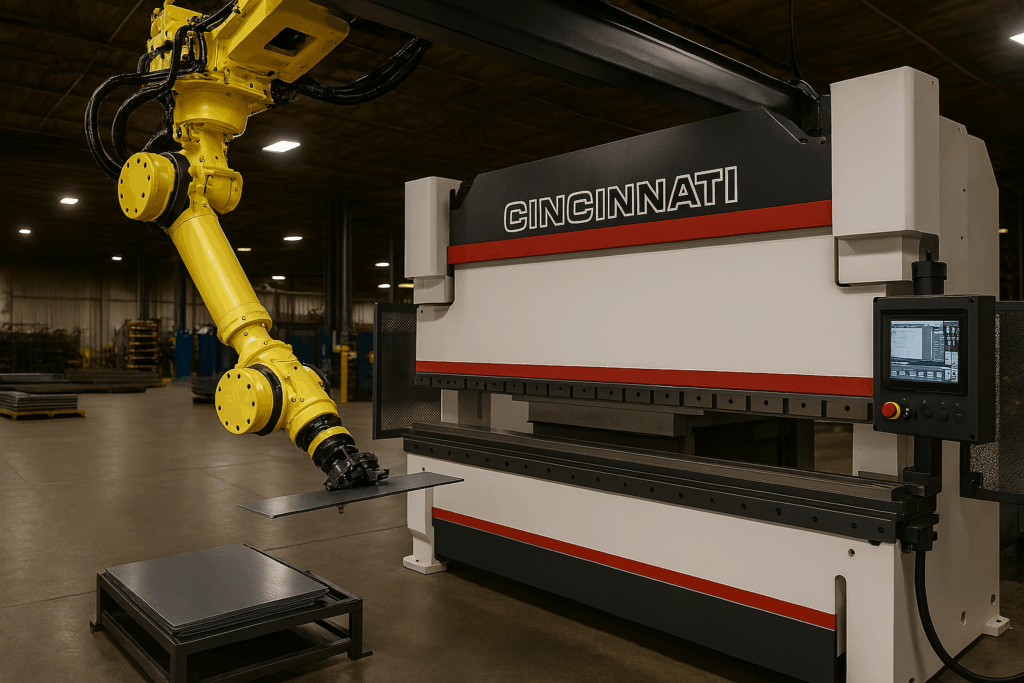
Smart cutting and bending systems integrate robotics and offline programming software to deliver highly adaptive sheet metal processing, eliminating time-consuming teach pendant programming in favor of program generation based off the desired geometries of finished components.
Robotic cutting and bending cells use real-time feedback, autonomous decision‑making, automated tool changing, and seamless robotic integration, enabling fully coordinated workflow across a fabrication cell.
These systems synchronize tasks such as sheet loading, laser cutting, and press brake bending through standardized communication protocols like OPC‑UA, enabling seamless interoperability with robots.
Why It Matters:
- Supports high‑mix/low‑volume jobs
- Reduces scrap and tool wear
- Enables autonomous part flow
- Greatly improves consistency
4. Robotic Material Handling & Assembly Automation

Material flow is often one of the biggest hidden bottlenecks on the fabrication shop floor. Automation in this area provides measurable improvements in safety, throughput, and flexibility.
Reports show that implementing robotic handling—especially in bottleneck‑prone areas like loading, storage, part transfer, and assembly—helps fabricators achieve significant gains in productivity.
Industrial robotics leaders such as FANUC and custom integrators like KC Robotics deliver solutions for pick‑and‑place, forming, assembly, and other high‑repetition tasks, helping operators focus on more skilled work.
Why It Matters:
- Improves workflow efficiency
- Enhances safety by removing ergonomic risks
- Standardizes processes across multiple shifts
- Provides scalability for future automation
5. Robotic Finishing, Grinding and Deburring

Finishing tasks—grinding, deburring, polishing—are among the hardest to staff due to their physical demands and precision requirements.
According to industry analysis, grinding and finishing systems are transforming high‑mix metal fabrication by automating previously manual operations without requiring complex fixturing.
Additional research highlights how robotic finishing systems reduce defects, improve repeatability, and handle dangerous or tedious finishing tasks more safely than manual labor.
Why It Matters:
- Automates dull, dirty, dangerous, repetitive finishing work
- Provides consistent surface quality
- Enables operator‑free inspection
- Reduces injury risk and labor dependency
Conclusion: Automation Is No Longer Optional—It’s the New Baseline
The metal fabrication landscape is evolving rapidly. Small-to-medium sized metal fabricators now have widespread access to affordable robotic automation. This adoption of integrated robotic welding, CNC tending, smart cutting/bending, material handling, and automated finishing are reporting significant improvements in cost structure, lead times, safety, and workforce flexibility. As automation solutions continue to become more accessible—even for small job shops—fabricators who embrace these technologies today will be best positioned to compete now and in the future.
| Rank | Automation Solution | Why It’s Top‑Tier |
| 1 | Robotic Welding Systems | Highest ROI, consistency, sensing upgrades |
| 2 | CNC Automation & Machine Tending | Reduces downtime, increases throughput |
| 3 | Smart Cutting & Bending Cells | Adaptive control, autonomous operation |
| 4 | Robotic Material Handling & Assembly | Faster flow, safer workflow, scalable |
| 5 | Material Finishing Systems | Automates grinding, inspection, high‑mix work |